

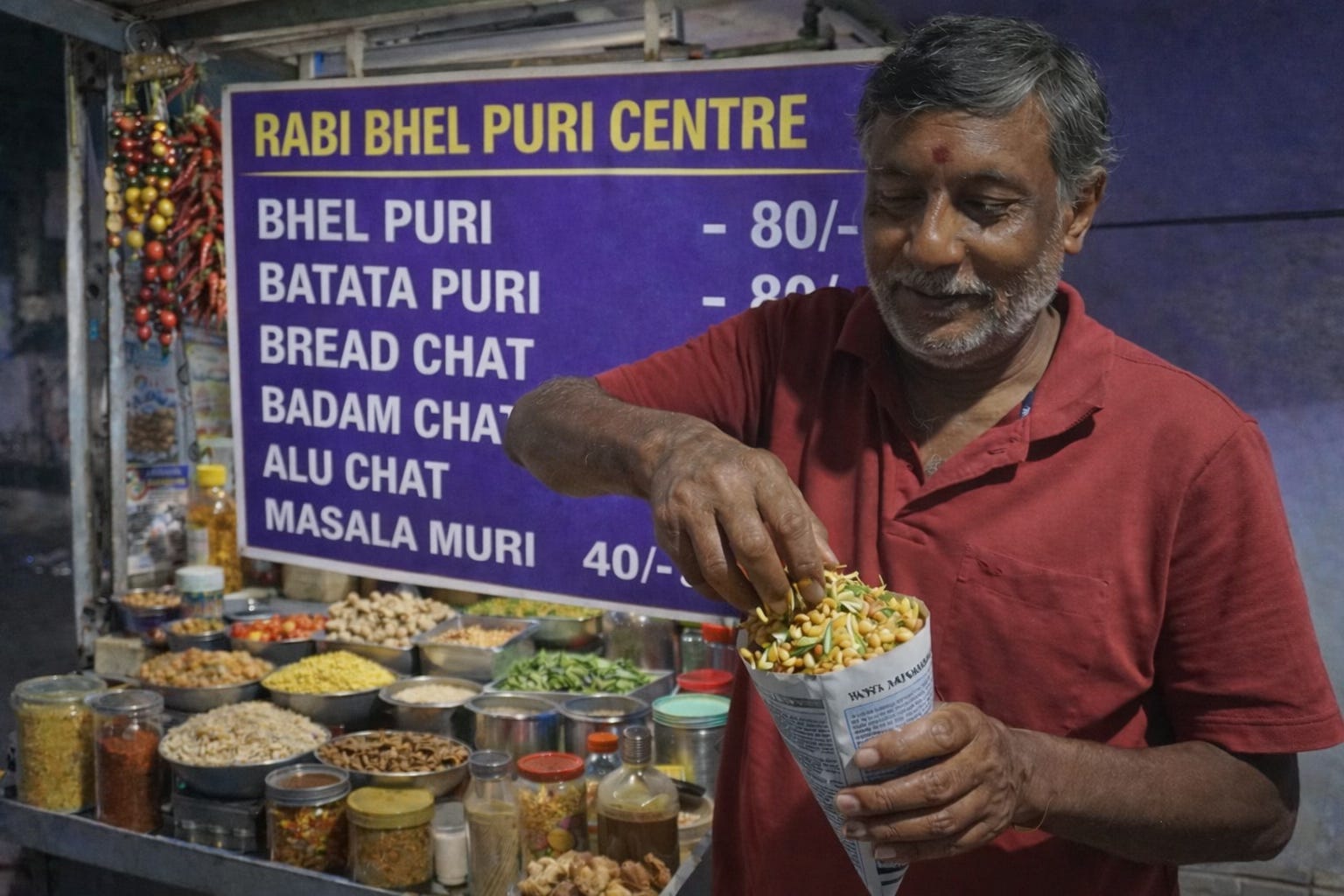
At the corner of two lanes in Kolkata’s Ballygunge area, beside a defunct lamp post, Rabi Da mixes jhalmuri in a steel container, his hands moving faster than the traffic. His display of the ingredients can hardly be described as a showcase of a shop: boiled potatoes, onions, tomatoes, chillies, lemons, bhels, papris, (fried savouries) peanuts, coconut slices, spicy masalas, sauces are stacked on a small portable table that serves as his counter. The pavement corner, bound by the lamp post and a couple of plastic stools for customers, is his shop.
Rabi Da has been selling his snacks at the same spot since 1978. There is no shutter to pull down, no rent to pay. His business is open as long as the pavement is there and as long as he wants to work. In his younger days, he sold from morning to evening. Boys and girls from the nearby school and college queued up for his jhalmuri, which he sold for two rupees then. For many workers from the shops and offices in the area, that was lunch. My wife has been his customer since that time, when she was in school.
In five decades, Rabi Da married and raised a family of three sons with the income from his snacks business. Ask him about his sons, and his eyes light up brighter than the neon bulbs in the mobile phone showroom across the lane. The eldest is a professor in a college; Rabi Da emphasises this with a nod. The second one works in a shopping mall and has skipped Holi celebrations for work. The youngest son is about to finish his college studies. All three live with him and his wife, the older two sons with their wives and children, Rabi Da tells us with pride in his voice.
Approaching 70, our jhalmuriwala is now happy to serve his regular customers for a few evening hours. His three sons are now well established, so he spends the evenings at his make-shift stand more for the pleasure of catching up with his customers than for money.
We have been his regular customers since our marriage, as regular as we can be, visiting the city once every few years. But whenever we are in town, we have to have Rabi Da’s jhalmuri at least once, rarely getting a chance to occupy one of his stools, more often waiting in a queue and enjoying the jhalmuri out of paper cones standing by his counter.
This evening, he is preparing jhalmuri for a couple and their small girl. Three portions with different amounts of chilli and spice, he is instructed. I hurry to place our order so he can make our cones of jhalmuri with theirs in the same mix. Very little chilli for me, lots for my wife. He nods at me, but ignores my haste.
After a second round of mixing and shaking, he hands us our jhalmuri, his fingers tapping the cones to settle the mixture. The crunchy puffed rice melts in the mouth, leaving the taste of mustard oil and tamarind sauce fighting with onion, coriander and chilli to overwhelm the tongue.
“I don’t mix the orders of different customers,” he says in a low voice, moving closer to us. “You see, I can mix the ingredients for five portions in the same container and make it together. But when I pour it into separate cones, the amount of peanuts and coconut pieces in the cones will not be distributed equally. That will not be fair to my customers.”
Rabi Da’s wares and his commitment to quality remain unchanged, even though his customers have dwindled in these five decades. The taste for quintessential Bengali jhalmuri and the Bombayiya bhelpuri have now been overtaken by the craze for momos, noodles, and grilled finger food. The neighbourhood is now crowded with shops, big and small, selling a new variety of snacks, eating into his clientele. There are other changes in the neighbourhood. The legendary sweets shop across the corner has closed. So have a couple of other shops nearby. A tall wall of blue metal sheets covers the ongoing construction in their space. A new shopping mall is rising behind that wall.
Rabi Da doesn’t grudge the changes. “It’s alright. Let there be more food choices, be it momo or noodles. Let them use any oil, any maida, any other ingredient; I don’t mind. What they shouldn’t use is Ajinomoto: it is addictive and harmful for the customer. I don’t ever use any artificial stuff, colour or flavour. Even my grandchildren eat this, and my sons are very particular.”
He narrates a recent incident. During Durga Puja last year, he was surprised to notice shaal leaf plates from his stall in the waste bin at home. When he enquired, he found that his eldest son had sent a friend to buy some items from him, posing as a customer. The son wanted to check if his father was compromising the quality of ingredients, taking advantage of the heavy demand during the Puja festivities.
At the end of the day, Rabi Da carries home all of his business: the folding table, the boxes and jars of ingredients, the plastic stools, even the waste bin. By night, the corner returns to being just a pavement again — no shop, no counter, no customers — only the defunct lamp post standing guard until the evening brings him back.
(The writer is a former journalist and communications professional.)
I love this story, well told!
How nicely you have narrated his story!