


The midnight bark
As I lay wide awake in my mother-in-law’s house, tucked into a narrow Kolkata lane and trying desperately to sleep around midnight, the skies opened up. Rain poured down in sheets, drumming on the window ledges and coaxing me into a half-daze. Just as I began to drift off, the lady next door came rushing out to persuade her son to go inside.
“Come back home, my baba, or else you’ll fall sick,” she pleaded. “Who will guard my home if you’re not there?”
But this wasn’t her human son — she was imploring a stray dog she had adopted as family. The dog remained unmoved despite her emotional appeals and gentle nudges. After a few minutes, she gave up and returned home under her orange umbrella. He continued to sleep nonchalantly in the rain, which cooled my nerves just enough to lull me back into slumber.
At around 3:00 a.m., sharp barking erupted in the lane. In this Kolkata neighbourhood, the barking of stray dogs is a familiar nighttime soundtrack — deterring not just thieves, but perhaps even our nightmares. It went on until dawn.
From sleep to scrolls
Having been shaken out of sleep, I found myself scrolling through news from the Supreme Court in the dim glow of my phone in the living room. I jumped in fright when my half-asleep wife appeared out of the shadows and asked, exasperated, why I couldn’t scare the dog away.
“Not so easy, my darling,” I said. “This dog has a family of stray siblings who’ll happily join in if you try to silence him.”
And therein lies the paradox that plagues India today. Stray dogs are everywhere — sometimes loved, increasingly feared.
The battle online and on the streets
In our housing society in the foothills, the residents’ WhatsApp group often erupts in howls of protest — some decry attacks, others defend the dogs. A recent spate of bites has made critics of strays more vocal. Senior citizens out for walks and schoolchildren heading to bus stops have become targets.
Yet the same strays protect us. They chase off foxes, leopards, and mischievous monkeys. Stories circulate of dogs saving lives. The conflict isn’t just physical — it’s deeply emotional.
Every week, tragic reports surface from across India: children mauled, joggers attacked, sanitation workers injured. Consider these recent news reports:
In Nagpur, dog bite cases hit record high, crossing 4,000 mark in 4 months of 2026.
In Ambala, a pack of dogs severely injured a 7-year-old boy. In Delhi, a man died after being attacked in a public park. In Bijnor, an elderly woman was mauled while working in her field.
At Delhi’s Safdarjung Hospital, dog bite cases surged from 63,600 in 2021 to 90,000 in just the first seven months of 2025.
On the other end of the spectrum, news reports have emerged of strays being brutally killed or disappearing mysteriously in Delhi and in Maharashtra.
The legal labyrinth
Stray dogs — often referred to as community dogs — have a right to be fed and cared for, but this must happen in ways that minimise conflict in shared spaces. The Animal Birth Control (ABC) Rules, 2023, part of the Prevention of Cruelty to Animals Act, 1960, aim to strike a balance between compassion and order.
The ABC Rules assign resident welfare associations (RWAs) or local body representatives the task of designating feeding spots and ensuring animal welfare. They also emphasise sterilisation and vaccination as the only proven ways to control the stray population and reduce rabies in humans.
India currently has 6.2 crore (62 million) stray dogs and reported 21.95 lakh (2.2 million) dog bite cases in 2024. WHO data shows India accounts for 36% of global rabies deaths, with 18,000–20,000 such cases reported annually.
The legal battle on the issue has been festering in various courts for the past two decades, with no resolution in sight. During 2006-2010, several High Courts saw clashes between public safety groups, RWAs, municipalities, and animal welfare organisations.
An influential ruling came from the Kerala High Court (in M. R. Ajayan vs. State of Kerala) in November 2015, which stated that human life must receive higher constitutional protection than stray dogs in situations of direct conflict. This reasoning later appeared repeatedly in Supreme Court arguments. The core legal conflict emerged clearly.
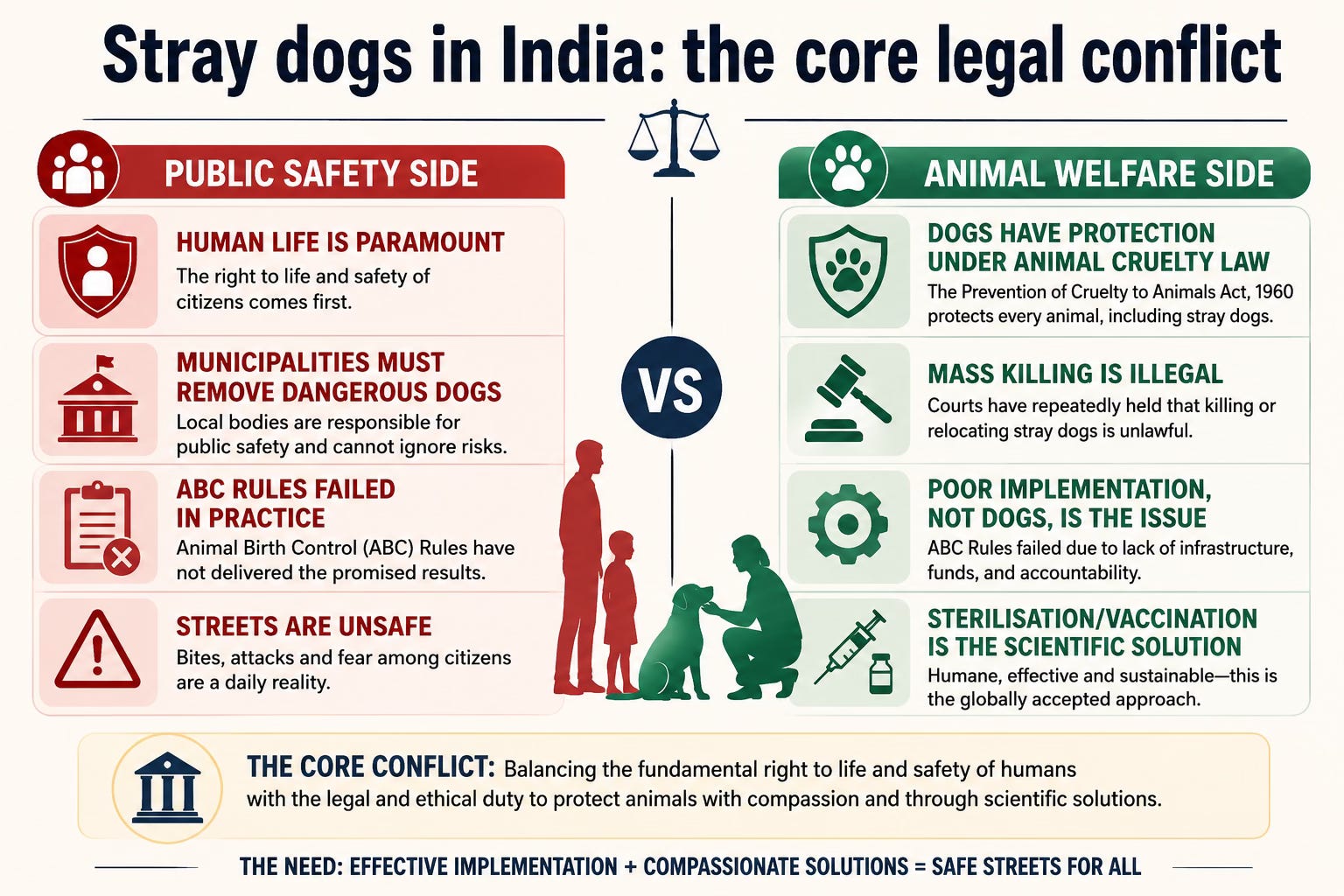
The issue reached the Supreme Court during 2015-2016 with several petitions filed by both sides. But for a decade or so, no clear national consensus emerged, nor did the courts lay down any clear path to resolve the issue. Meanwhile, stray dog populations continued growing in many cities, sterilisation targets were often missed, and municipal infrastructure remained inadequate. Recurring flashpoints appeared across India, doglovers and feeders claimed protection rights, RWAs demanded removals, municipalities blamed lack of funds, and animal welfare groups accused authorities of illegal killings. The dispute became intensely polarised.
In 2023, the Central Government notified the ABC Rules, 2023, updating the existing 2001 framework. The Rules reinforced the principle of sterilisation, vaccination, and release of stray dogs; imposed obligations on local bodies; recognised community dog feeding zones; created monitoring structures; and formalised handling protocols. Supporters called the Rules more humane and scientifically aligned, but on the other hand, critics argued the Rules still made removal of aggressive dogs too difficult.
A turning point came in August 2025 when the Supreme Court made a dramatic intervention following reports of severe dog-bite incidents, and the death of a young child reportedly linked to rabies. The Supreme Court initially ordered large-scale removal of stray dogs from Delhi-NCR streets and permanent relocation to shelters.
Protests and protestation
Reflecting the polarisation on the issue, the Supreme Court order triggered nationwide protests, opposition from animal welfare groups, claims that shelters were inadequate, and fears of mass incarceration or deaths of dogs.
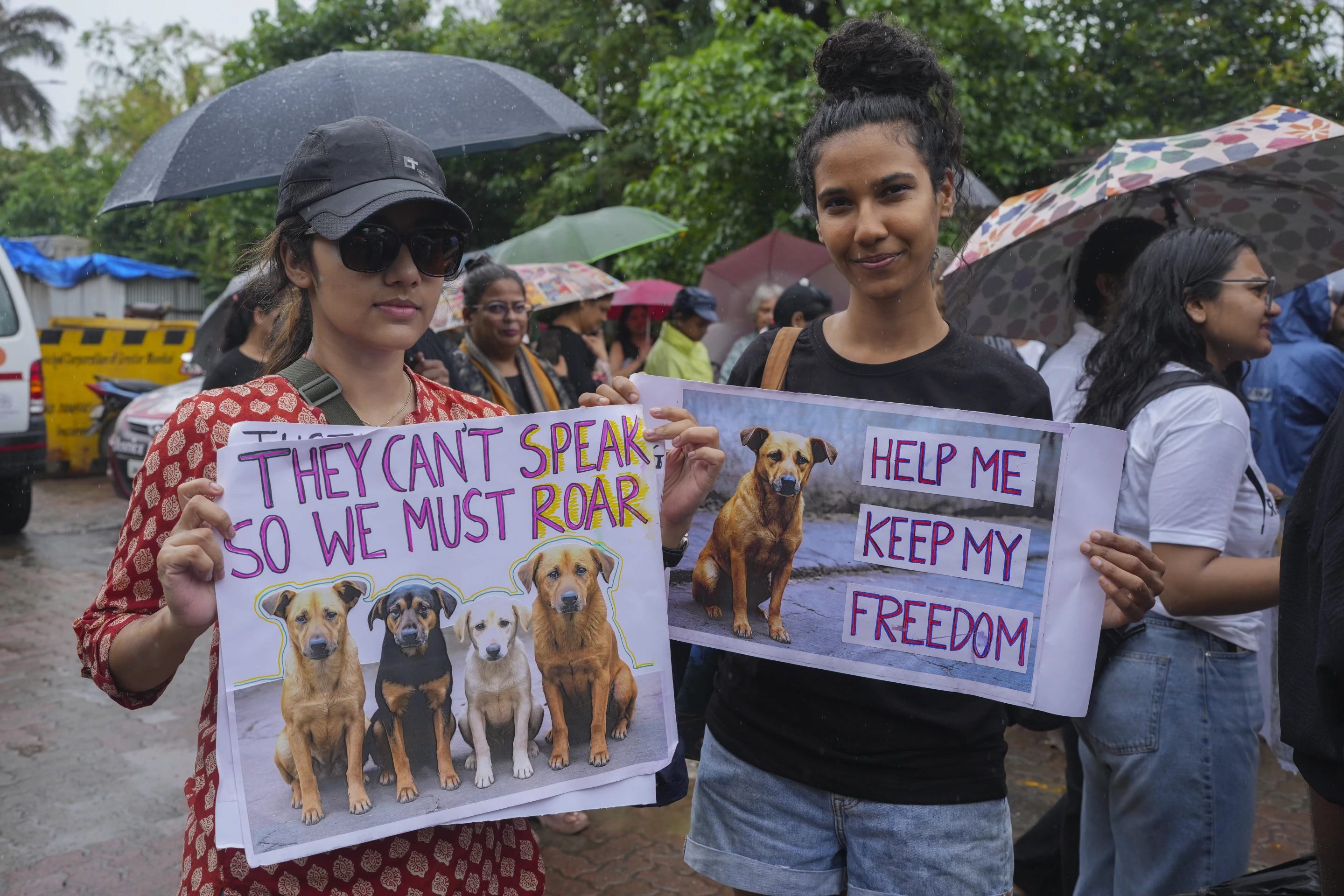
After backlash, the Supreme Court modified the order, ruling that sterilised and vaccinated non-aggressive dogs could be returned to their territories, but aggressive or rabid dogs should not be released into public spaces.
The Court also expanded the issue nationally, asked states to frame proper management systems, and encouraged designated feeding zones. This was seen as an attempt to balance public safety, animal welfare and administrative practicality. A few months later, the Supreme Court broadened its directions nationally and fixed the responsibility of implementation on states and municipalities.
End of the story? Not yet. Animal welfare groups challenged the Supreme Court directions.
The latest major ruling by the Supreme Court came yesterday (19 May 2026): the Court refused to modify or recall its earlier 2025 directions on managing stray dogs in public spaces. The Court held that the right to life and safety of citizens under Article 21 must take precedence where there is a conflict between public safety and animal welfare.
The Supreme Court has upheld its earlier directions that stray dogs should be removed from hospitals, schools and colleges, railway stations, bus stands, sports complexes, and other high-footfall public places. The stray dogs are to be sterilised, vaccinated, and shifted to designated shelters under the ABC Rules, 2023.
The Court also observed that states and municipalities had failed for decades to properly implement sterilisation and vaccination programmes, dog-bite incidents had reached “alarming proportions,” and human dignity includes the right to live without fear of dog attacks. The Court also permitted euthanasia of dangerously aggressive or rabid dogs where legally necessary and medically justified.
Stalemate in the streets
Still, the question of aggressive strays remains unresolved. Even if vaccinated, a violent dog can traumatise or even kill. Feeding programmes in cities like Bengaluru have been criticised as misplaced priorities when safety is at stake, yet leaving the strays hungry increases the risk of them becoming aggressive. Now that the Supreme Court has made it the responsibility of local authorities to determine when a stray dog is to be euthanised, one wonders what parameters the authorities possess to make such a decision.
Citizens seek safety. Municipalities promise action, but sterilisation is often their only recourse. Animal rights activists fight for the dignity of these animals. No one is entirely wrong. But the balance? That remains elusive.
In our housing society, the strays rule the roads. Some residents feed them lovingly. Others shoo them away. Most fear them. These animals are neither truly free nor truly domesticated. They survive on scraps and kindness, yet resist training and discipline. And we live in the middle of this uneasy truce: torn between compassion and fear, empathy and frustration.
I understand the orange-umbrella lady’s affection for her baba. I’m not a pet owner myself, but I’m comfortable around animals. At the same time, I understand my wife’s dread and my daughter’s phobia — after all, she was scratched by a pet dog during playful roughhousing. I see kids cross the street to avoid barking dogs, and I know neighbours who put out food every morning and evening.
A conversation we must have
Somewhere between these opposing instincts lies a conversation we need — not just in courtrooms, but in housing societies, municipal offices, and schools. Stray dogs aren’t just an animal control problem. They are a mirror reflecting our fractured approach to urban planning, public health, animal welfare, and community responsibility.
It’s not enough to feed them. We must also care for them when they’re sick, manage them when they’re violent, and protect the people who share the streets with them. Shelters, sterilisation, medical care, and community education must all be part of a serious, national conversation. There is something to learn from the Netherlands, which got rid of the street dog menace in a humane manner.
In fact, we may have an example to follow closer home. The Ward No. 100 of the Ghaziabad Municipal Corporation, a township in Ghaziabad’s Indirapuram, has become the first civic ward across Uttar Pradesh to achieve nearly 100% sterilisation of all its community dogs, with residents, RWAs, animal feeders and NGOs working together. Residents say that this has stabilised the dog population, reduced aggression, reduced territorial fights among the strays, and lowered the fear of stray attacks.
Last night, I tried to sleep. I listened to the endless barking of stray dogs from our housing complex. But this morning, the thought persists — louder than the howling:
Until we decide what to do about our community dogs, they will remain our shadow selves — loud, attacking, unloved, and feared.
(The writer is a former journalist and UN communication professional.)
I had no idea. Insightful and well written, as always!