

“This is the best spot for committing suicide,” a man shouts in Bengali. “Onno khane dhora pore jabe!” (You will get caught at other places.)
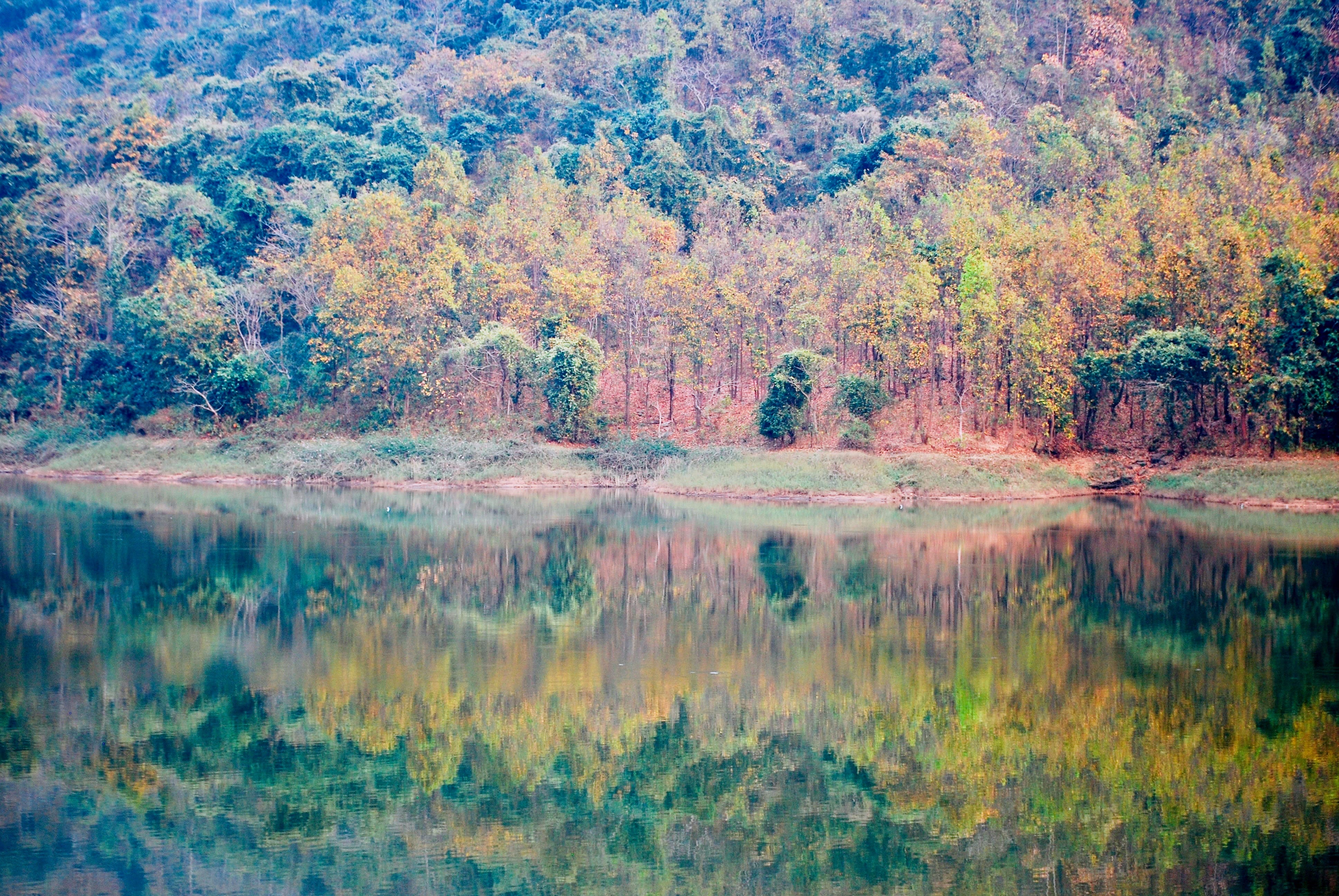
The remark hangs oddly in the air, cutting through what is otherwise a postcard-perfect evening at Khairabera Dam. We have come for the sunset, after a long, winding drive through tribal villages and narrow, serpentine roads. The place earns its reputation easily: an artificial lake spread wide among undulating hills, its surface holding the sky like a patient mirror. Trees along the slopes are turning — yellow, orange, rust — before they shed their leaves in preparation for spring. A soft mist drifts across the landscape, blurring its edges into something almost painterly.
For a long moment, the sun lingers like a ripe orange, suspended between sky and water, before slipping quietly into its own reflection in one of the water channels.
It is toward one of the many canals heading out from the reservoir that the man’s family has wandered, prompting his warning. The line, jarring at first, settles into the scene with a strange logic. Beauty here is edged with risk; admiration requires distance.
As the sun disappears, the air cools quickly. Tourists gather around a makeshift tabletop stall where three men pour tea sweetened with nolen gur, the liquid jaggery made from date palm sap. The tea carries a smoky, caramel warmth that lingers on the tongue, inviting slow sipping. We order a second round in small earthen bowls, each costing twenty rupees.
One man protests loudly in Bengali, “Oi bhand kuri takar hotei pare na!” (That cup of tea cannot cost twenty rupees!)
His complaint, half-serious and half-performative, draws amused glances. The rhythm of indignation and humour feels as much a part of the landscape as the hills themselves.
Nearby, a signboard advises, “Don’t wrap your life in plastic.” It stands planted in a heap of discarded plastic bottles. Not far away, the stream at Bamni Fall carries plastic wrappers and bottles along with its water. The message survives; the meaning seems to have slipped downstream. I find myself wondering, not for the first time, who exactly the joke is on.
The roads that brought us here had their own commentary. Painted signs appeared at intervals, offering wisdom with a peculiar earnestness:
“Friends don’t encourage friends to drink and drive.”
“Better to be Mister Late than to be Late Mister.”
“Safety on the road, safe tea at home.”
They read like fragments of advice addressed to no one in particular, yet meant for everyone passing through. At regular intervals, we are reminded that the road is maintained by the state public works department. No such signs are visible where the roads need maintenance.
Earlier that morning, we had driven to Pardi Lake, another quiet stretch of water reached only by negotiating barely motorable roads threading through clusters of tribal huts. The journey promises solitude, and for a while, it delivers. The forest shifts in colour as you move through it, offering small, patient rewards for the effort.
But quiet, here, is rarely absolute. On the lakeside, a middle-aged couple breaks into a loud quarrel. The wife accuses the husband of bluster at home and timidity elsewhere; the husband, in a green T-shirt and a faintly incongruous crown of hair, smokes a beedi in embarrassed silence. Minutes later, he is on the phone, negotiating urgently over money, insisting he is not bluffing. The private spills easily into the public, as if the landscape itself refuses to hold secrets for long.
By evening, we are back on the road, leaving Khairabera behind. The dust rises as vehicles hurry toward the highway connecting Jhalda to Baghmundi. The stillness of the afternoon gives way to motion and noise. Today, that movement carries a purpose: trucks and jeeps filled with BJP workers and supporters stream toward a rally.
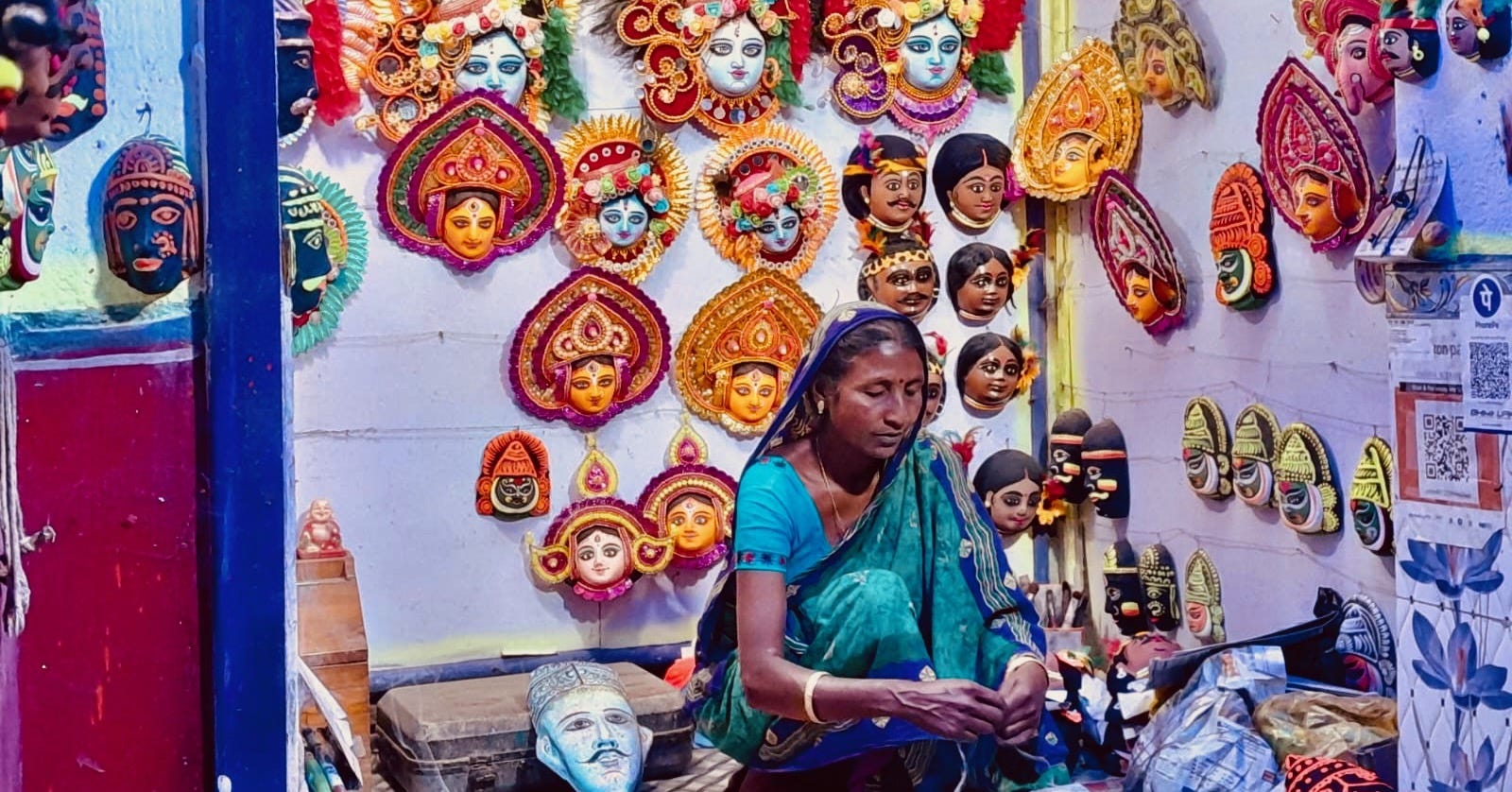
On the way, we stop at Chorida, the Mukhosh Gram — the village of masks. In a small roadside home, Chanchala Sutradhar manages her shop while her sons are away exhibiting their work. Masks crowd the walls: Ganesha, Durga, Krishna, Shiva, alongside figures drawn from local tribal life. Their colours are bright, almost defiant. She speaks with easy pride about their craft, about orders from fairs across the country, about supplying full sets of masks to Chhau troupes who perform the epic stories of the Mahabharata and the Ramayana. There is no suggestion here of a dying tradition, only the steady rhythm of work and adaptation.
When we reach Baghmundi, the road slows to a halt. A large crowd gathers before a brightly lit stage. Nearby, a group of Chhau performers waits in costume, their colourful masks catching the artificial light. A slogan blares through loudspeakers: “Paltano darkar, chai BJP sarkar.” (Change is needed; we want a BJP government.) Will this wish remain only a wish? The voters will decide in a few weeks.
As we round up our time in Purulia, what the days reveal is not contradiction but consistency. We do not enter landscapes; we overwrite them. With waste, with noise, with politics, with ourselves, with our anxiety and frustrations. The dam, the lake, the village, the road, they hold their shape, but cannot maintain their silence. And perhaps that is the real discomfort: not that beauty is fragile, but that we are so reliably careless with it.
(The writer is a former journalist and communications professional.)
Some more beautiful writing 🤗