

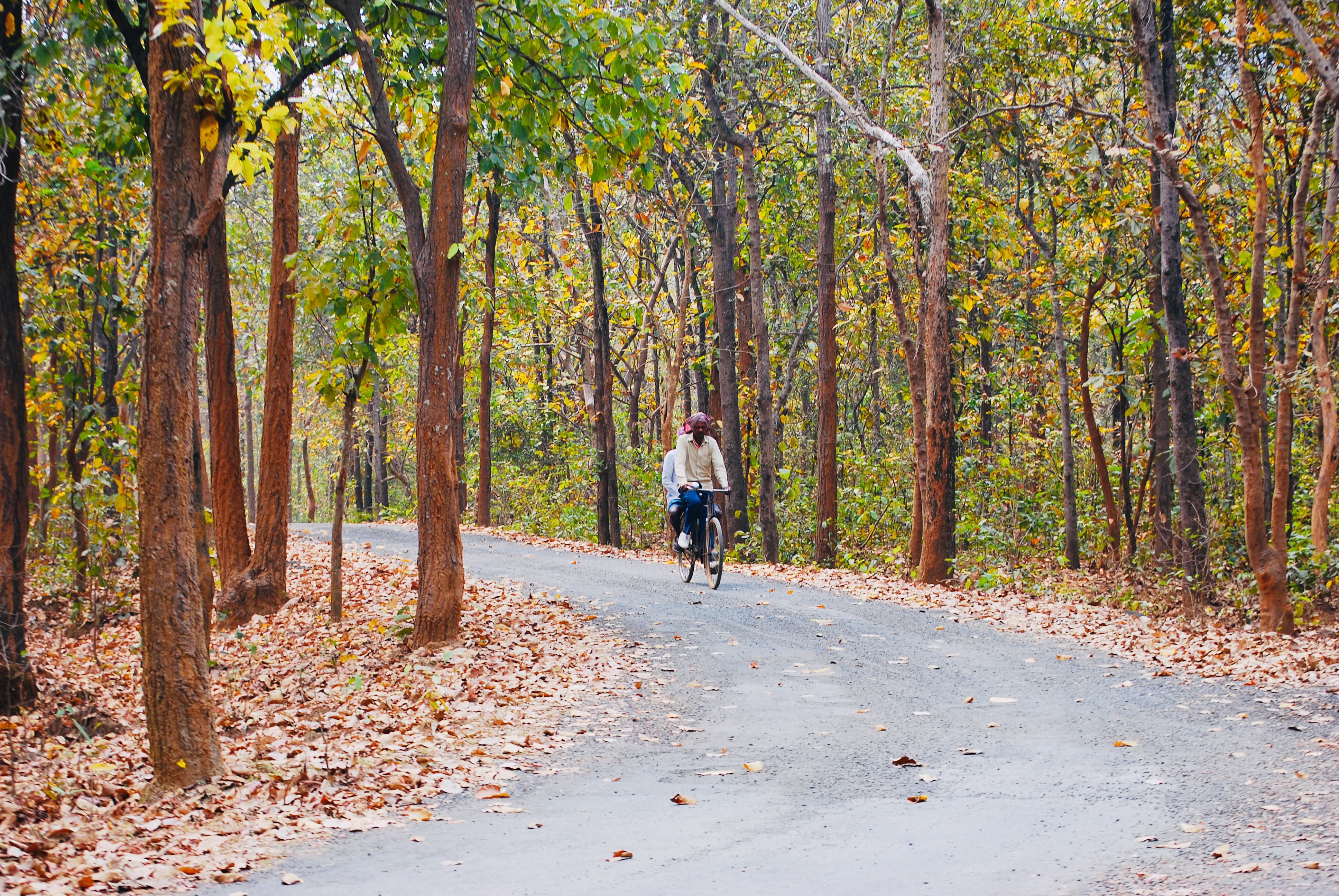
It turns out we have landed too early in Ajodhya Hills, before the Palash flowers could bloom. Local resorts, tourist guides, and past visitors had created the impression on Facebook that the hills turn into a glorious orange-red forest around Holi, like European autumn woods. We missed a crucial detail: Holi arrived almost three weeks early this year.
Read about our search for Palash in Ajodhya Hills
But the forest is dressing for the occasion, assembling a slow-burning canvas of colour. Trees are shedding leaves in the springtime patjhad; the edges of the forest roads glow with a golden carpet of fallen leaves. Kusum (Ceylon Oak) trees wear new leaves in shades from pink to deep red. Sal (Shorea robusta) trees flush red, a sign of life’s revival after winter. Peepal (Sacred Fig) trees unfurl tender leaves tinged with reddish bronze. Palash leaves are turning brown. Bougainvillaea along the roadside burst into reds, pinks, and fuchsia. Shimul, or the Silk Cotton Tree, tries to set the forest on fire with its blood-red flowers, often fooling travellers like us into mistaking it for Palash. The crown of the season, of course, will be Palash — the Flame of the Forest — which will outflame them all.
On the way from Asansol, after we leave the national highway for a slower state road to Ajodhya Hills, we spot a splash of orange in the distance, a few kilometres ahead. Even our driver, Yadav Ji, usually a quiet conversationalist, leans forward and urges the car faster.
As we draw closer, the colour resolves into BJP flags tied to tree trunks along the highway. The party’s Parivartan Yatra, a statewide campaign ahead of the Assembly elections, is due to pass through the Purulia region around this time. The flags grow larger and denser near Baghmundi, where a rally is taking shape. But the incumbent TMC (Trinamool Congress) is not to be outdone; its workers have inserted their own flags, also streaked with orange, into the same rows. From a distance, it resembles a contest of colour, not unlike the rivalry between Shimul and Palash.
Even the railings of bridges are lined with BJP flags. I find myself wondering: if the party’s fortunes do change, will the state’s bridges, offices, and factories shift from blue and white to saffron? The current palette bears the imprint of the chief minister’s signature clothing style as much as it does the state’s administrative identity. Whether that changes may depend on if the Bengali bhadralok trusts her rule has reached the grassroots, as her party’s name promises.
Trust travels easily in rural India. At Dulalpur, near Nadhutati bus stand, we stop at a corner shop for tea. The young shopkeeper serves milky, sweet tea with salty, puffy biscuits. A frail old woman, easily in her seventies, gets down from a bus carrying two bags of paddy. She asks the shopkeeper, in Manbhumi Bengali laced with Hindi, if he will keep them for the day; she cannot reach her grandson on the mobile phone to collect her.
I ask where she is headed. “To the village,” she says, pointing toward the road to Unanshila.
The shopkeeper asks which family she belongs to, then agrees without hesitation. No documents, no proof, just recognition and trust. She leaves the bags and walks on.
We spend a couple of quiet days in a new resort in Matha Pahar. Other resorts nearby are full of tourists who fell into the same Facebook trap as we did, so we have this three-month-old place, with its basic facilities and unhurried service, mostly to ourselves.
We wake to the melodious racket of parakeets, koels, bulbuls, and mynas crowding the treetops. Morning tea promised at seven arrives at eight. Breakfast of luchi-tarkari feels heavenly after the wait. Peacocks keep us company, loud and insistent, as we wait again for evening tea after an afternoon nap. Meals arrive slowly, sometimes cold, even when already cooked; but where else would we find the taste of home-cooked macch-bhat or murgir jhol, finished with cotton-soft rosogollas? We accept the pace for the sake of the palate.
The young cook-cum-manager, Bishwambhar, falls ill but continues to cook and manage for us and for guests at their other property. His lieutenant, Anima, a young Adivasi woman, handles housekeeping and helps in the kitchen. They are joined by Munna, a boy who waters the plants and assists where needed. Beyond brief exchanges with them when they come to serve or clean, the resort settles into the forest’s quiet.
Quiet places have quiet dogs. Bishwambhar cares for three strays that have made the resort their home. They lie in the shade near the half-built dining area, moving little, unbothered, asking for nothing, as if they have always known what we were only beginning to understand — that not every journey rewards you with spectacle. Sometimes you arrive too early for the story you came looking for, and just in time for the one you didn’t know how to read.
(The writer is a former journalist and communications professional.)
Purulia Journal, Part 1: If Wishes Had Wings