

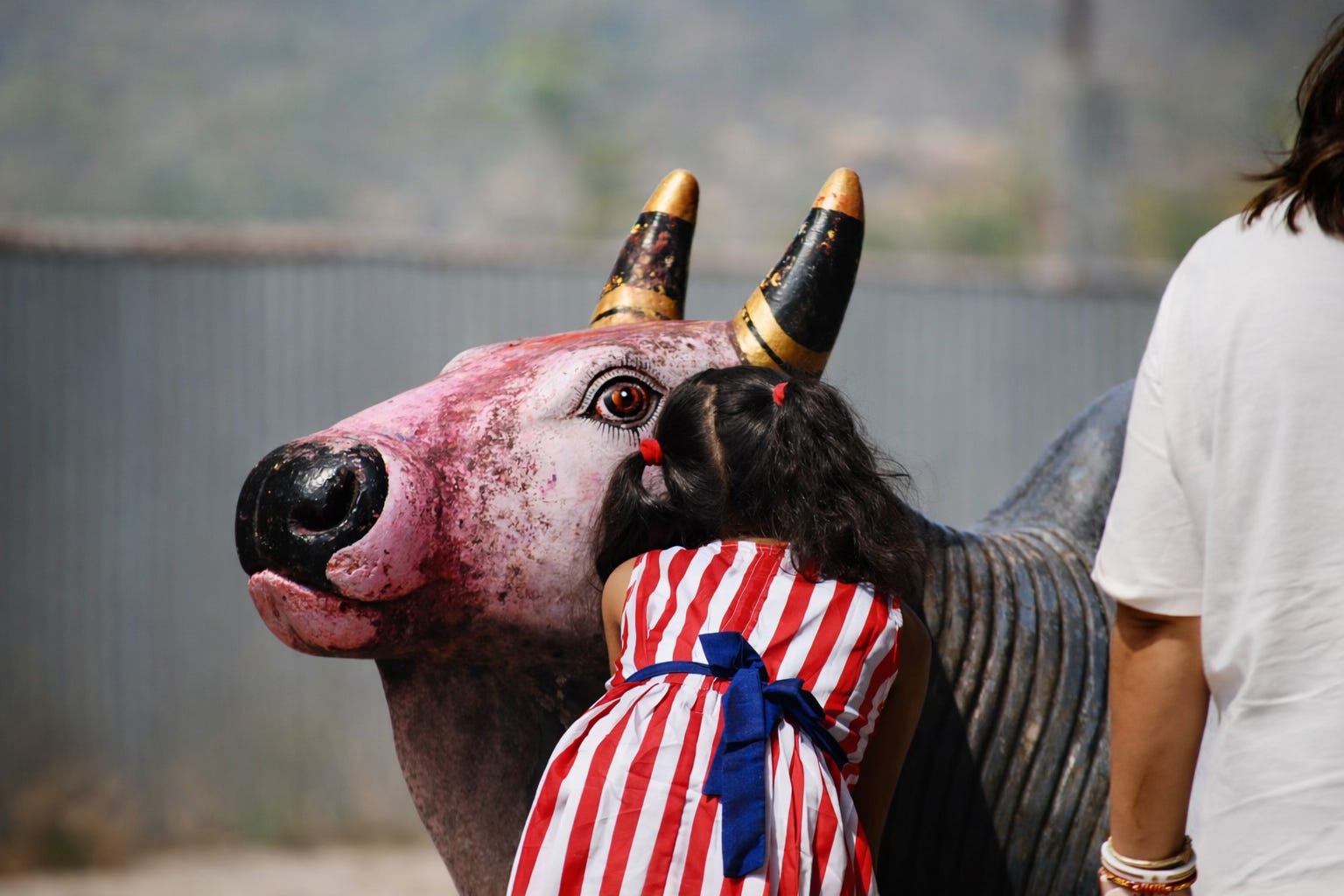
A little girl leans into Nandi’s ear, whispering a secret. She is in a white-and-red striped frock with a blue belt tied around her waist, and her hair parted into two pigtails, each tied with a red band. Her mother is standing by. Nandi, the bull vahana (mount) of Lord Shiva, is all attentive, his head tilted up and eyes large with intent, and ears perked up.
Perhaps she is asking for an iPhone for her birthday. Or maybe she wishes for Lord Shiva’s blessings to achieve her academic goals. Her wish is a secret shared with only Nandi, who is trusted to carry the devotees’ wishes to his master with a definite outcome.
Wishes. If wishes had the magic power, my wife and I would not be standing here disappointed.
We are at the Lahariya Shiva Mandir on the banks of a serene lake. This is in the Ajodhya Hills of Purulia, in West Bengal. They say this temple is more than 1,000 years old, though its current structure wears a new face, built over the older ones. There are smaller temples for other deities around the premises. Cemented platforms around tree trunks embrace devotees, old and young, into restful repose. Goats are munching leaves scattered on the ground. A bespectacled man wearing a white T-shirt with blue stripes and a blue baseball cap is bending forward to feed a goat.
A group of devotees, some of them visiting like us, is crowding the small sanctum sanctorum, where the black Shiv Lingam is covered with a golden cage-like ornament. A priest is reciting Sanskrit shlokas to help devotees present their offerings to Lord Shiva and seek his blessings. Dong… The large bell at the entrance shudders the air, while smaller bells answer in a scatter of ting-ting-ting, as devotees ring them to mark their entry to the god’s residence.
We take a quick darshan and walk around the small perimeter thrice. I didn’t want to visit the temple as such. What’s the point when the main purpose of our visit is not achieved, I argued in a frustrated mood. This is our second day in Ajodhya Hills, whose forests are supposed to be flaming red and orange at this time of spring, with orange Palash (Flame of the Forest) flowers and red Shimul (Silk Cotton Tree) in full bloom. We have travelled eight hours from Kolkata to experience and photograph this visual extravaganza. Our car has criss-crossed all the hills and forests of the region in search of what cannot be seen: Baghmundi, Mathaburu, Sonkupi, places that now blur into one long, fruitless search. We have touched all the tourist spots: Lower Dam, Upper Dam, and Marble Lake. Our odometer shows that we have covered more distance in the forests than the 300 kilometres from Kolkata. We have seen no Palash in bloom, though.
My memories of wishes unfulfilled on other occasions flare up. We have been to the Jim Corbett National Park thrice chasing the camouflaged tiger. The mahouts of the safari elephants have pointed out their footprints and sometimes other signs, told us stories of close encounters, but the tiger never showed up to prove it exists. The same happened in the Rajaji National Park, where we spent hours in a safari jeep in a futile effort to be terrified by a wild elephant charging at us. Our wishes were not fulfilled by Bon Bibi (Lady of the Forest) in the Sundarbans either. At the edge of the mangroves, we bowed to Bon Bibi, the unseen mistress of the tides, trees and tigers, and rowed narrow water channels through mangrove roots, but the tiger was not to be found.
When I don’t get what I wish for, I get agitated. I fume at the unfairness of life. All my planning and expenditures have been in vain. So many others have seen it and shared it on Facebook, so why can’t I? Why doesn’t God approve my wishes but approve those of others?
In this agitated mood, I turn my camera towards the people around the premises. On one of the platforms around a tree trunk, local boys are selling their handcrafted goods: small purses, toys, and memorabilia such as magnets. A couple of ragtag stalls are selling similar items alongside Chinese toys and gifts. A boy is making and selling garlands of… Palash.
I pause. My camera zooms in. The orange looks too alive, too soft to be plastic. On the way here, I had spotted a similar garland at a roadside shop as our car zipped past and dismissed it as a cheap imitation from China. But these, these are different. Real.
I step closer. The petals are tender, almost velvety, their bright orange curling like parrot beaks, held together by dark green sepals in a cascading fold. They don’t just look real, they feel it.
“Ei phool kothai pele, baba?” I ask, unable to hide the surprise in my voice. (Where did you get this flower, son?)
“Gacch theke!” he replies, a flicker of amusement crossing his face. From the tree. Of course.
I tell him we have searched for two days and found none. He looks at me, puzzled, then lifts his hand and points.
I turn. And there it is. Just outside the temple boundary wall stands a tall Palash tree, ablaze in orange. A cuckoo sits on a bare branch, cleaning its beak, as if indifferent to the quiet miracle unfolding below.
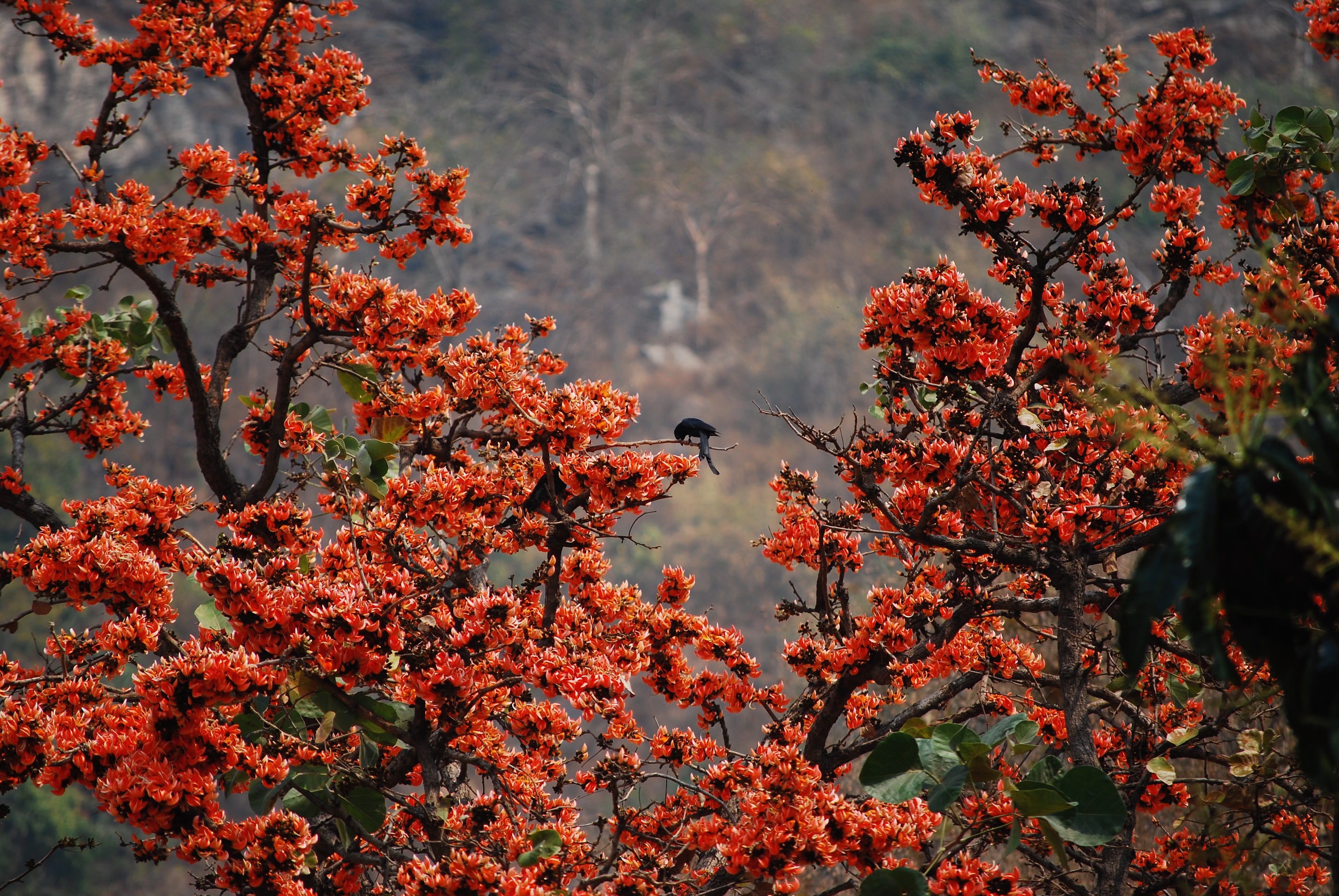
After all the miles we had covered, all the hills we had crossed, it had been here—within reach, waiting without announcement.
Almost as an afterthought, I lift my camera and take the picture, as if proof will make the moment real.
For a few moments, I stand there, looking at the tree, like it might disappear if I look away. After two days of searching, of scanning hillsides and forests in quiet frustration, it feels almost absurd — this easy, unannounced presence. It is not the same as seeing the entire forest in flames, but the search itself is more insightful than what I found. Not all wishes are to come true, not in the form we wish anyway.
Perhaps this is how it happens. We find the destination not in the places we exhaust ourselves looking, but in the ones we almost overlook.
My gaze drifts, unhurried now, to the far end of the temple grounds. A wave of orange and red hangs mid-air.
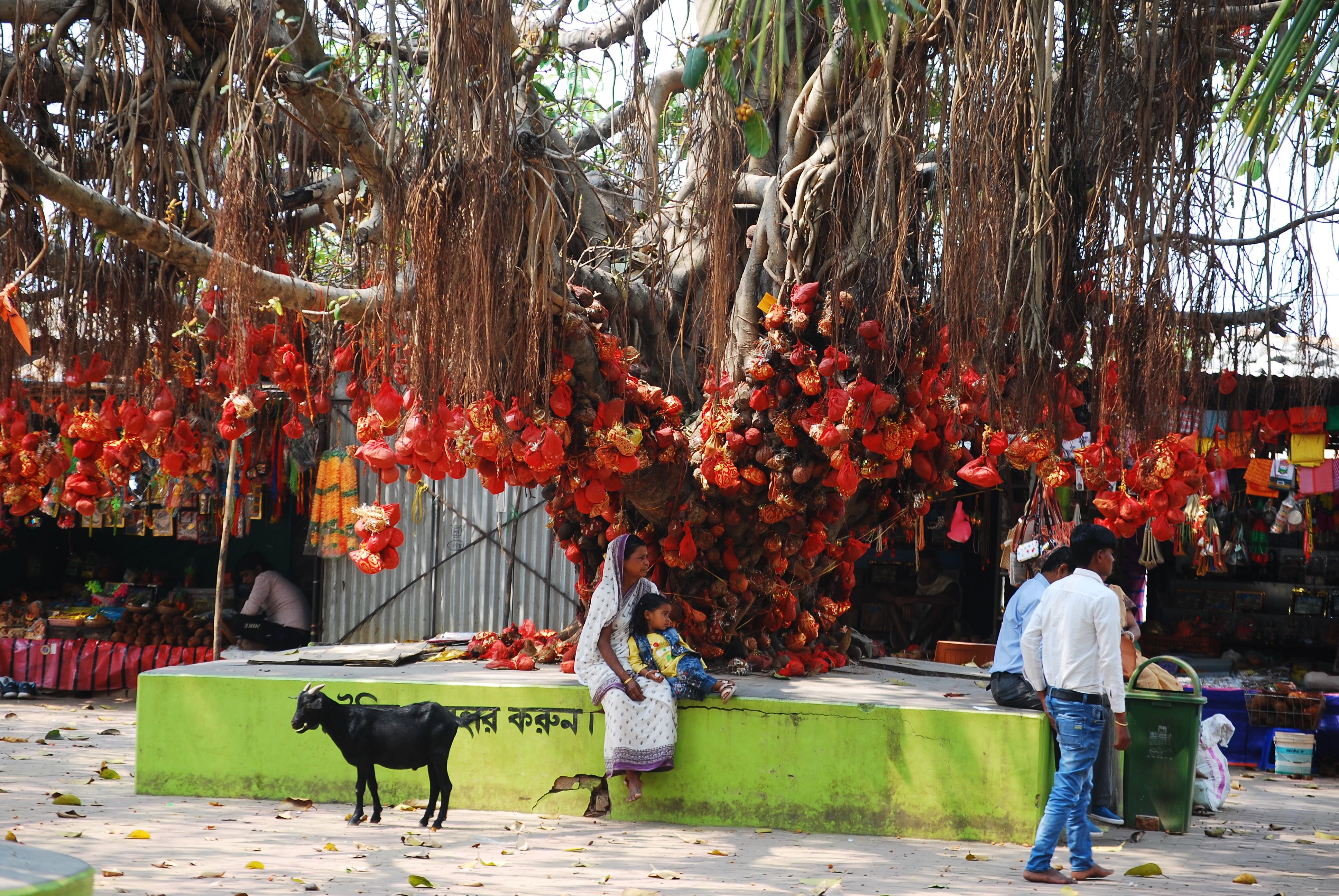
An ancient banyan tree stands there, its aerial roots heavy with the burden of devotees’ wishes—strips of cloth tied in quiet hope, each knot holding a desire, a plea, a promise deferred. When their wishes are fulfilled, the offerings are taken down, relieving the tree of the weight.
I wonder how long some of them have been waiting.
If wishes had wings, they would not hang here so patiently, learning the weight of waiting.
(The writer is a former journalist and communications professional.)
Delightful piece. And yes, if we were not at times too busy throwing tantrums as our mind cannot accept that we do not get what it wanted, we would notice and enjoy so much more. The traps of human condition 😅