

It is a dream sequence. I open my eyes, still in bed, and there rise before my eyes waves of mountains, draped in parrot green silky blankets of foliage, dotted with thick deodar groves in darker greens. Misty clouds float up from the valley, mystifying the rising sun into an artist’s incomplete brush strokes. Birds small and big, restless and quiet, noisy and less noisy, flit around the shrubs and trees, tweeting non-stop to draw attention of their own kin and the other kind, like us.
Life is on a slow roll for us here in the mountains of Chakrata in Uttarakhand where we are in retreat for a couple of weeks. The quiet, peaceful environs of the boutique homestay Harul lends itself the mystic air worthy of an artist’s indulgence: the monsoon clouds, as restless as the birds and butterflies, hover around the cottages, hiding the mountains, before rising up in preparation for coming down later in downpours when the mood is right.
Free from daily household hustles, Maitreyee (my wife) is busy bringing her canvases alive with the colourful sights in front of her. It is not difficult to see why many artists and writers choose to live close to nature for inspiration and creativity. Think of Henry David Thoreau, Rabindranath Tagore, D.H. Lawrence, Vincent van Gogh, Ruskin Bond.
Nature is slow by design for a reason. It allows things to seed, sprout and grow to full potential in time. It asks to live in the instant, here and now. The modern human longing for instant gratification doesn’t allow for cherishing the moment, leave alone creating something long-lasting.
Everything from housekeeping to food at the homestay is taken care of by the efficient staff of Harul, run by its friendly and ever cheerful owner Neelam Ji. She has built the place mixing Wabi Sabi and Boho styles, using local timber, stone, and mud. Her discerning eye for the beauty in the unpolished and raw is visible in the materials and artifacts from nature used all around, like a huge fossilized mushroom in the dining hall display.
Neelam Ji treats her guests with home-made organic food of the local Jaunsari cuisine: mandua ki roti, mash aur lal chawal ki khichri, hara saag, cholai ke lobre, hemp seed chutney. Served alongside are stories sombre and sunny: about the local village culture and politics, her deep insights into behaviour and relationships, and from living and working in Dehradun, Lucknow and Mumbai. The chats over shared meals often turn boisterous, rendering the freshly built dining hall a familial ambience.
Except the weekends when guests from Delhi and nearby cities fill the remaining rooms, we have enough solitude to indulge in daydreaming and nature gazing. The quiet is pleasantly paused by the lilting laughter of two girls on the swing — Shreya and Shruti, daughters of housekeeper Sapna.
In the afternoon, we wander around the mountain roads, led by Minty, Harul’s resident mountain dog, who otherwise spends the day resting in the lazy sun or hunting mice, birds or shoes, not for food but as practice of her natural instinct.
On some days, Neelam Ji and her American Bully named Moscow join us on the walk, the dog as friendly as his parent despite his breed name. The third member of this canine gang, a chihuahua named Mia, is away with her other parent, Neelam Ji’s husband Rahul Ji.
Neelam Ji takes us on an exploration of local herbs, berries and fruits, all covering the mountain sides without a care from or for humans. The walk turns out to be an exploration of our taste buds, as much as the meals themselves.
We meet other familiar faces on the road, people from the village who we have met earlier, going about their daily life. Soniya Ji, a mother of four, carries a bundle of wet fuelwood home. She rests the load on an elevation on the hillside to allow us to take a photo with her and hoists the load up her back to resume the strained walk.
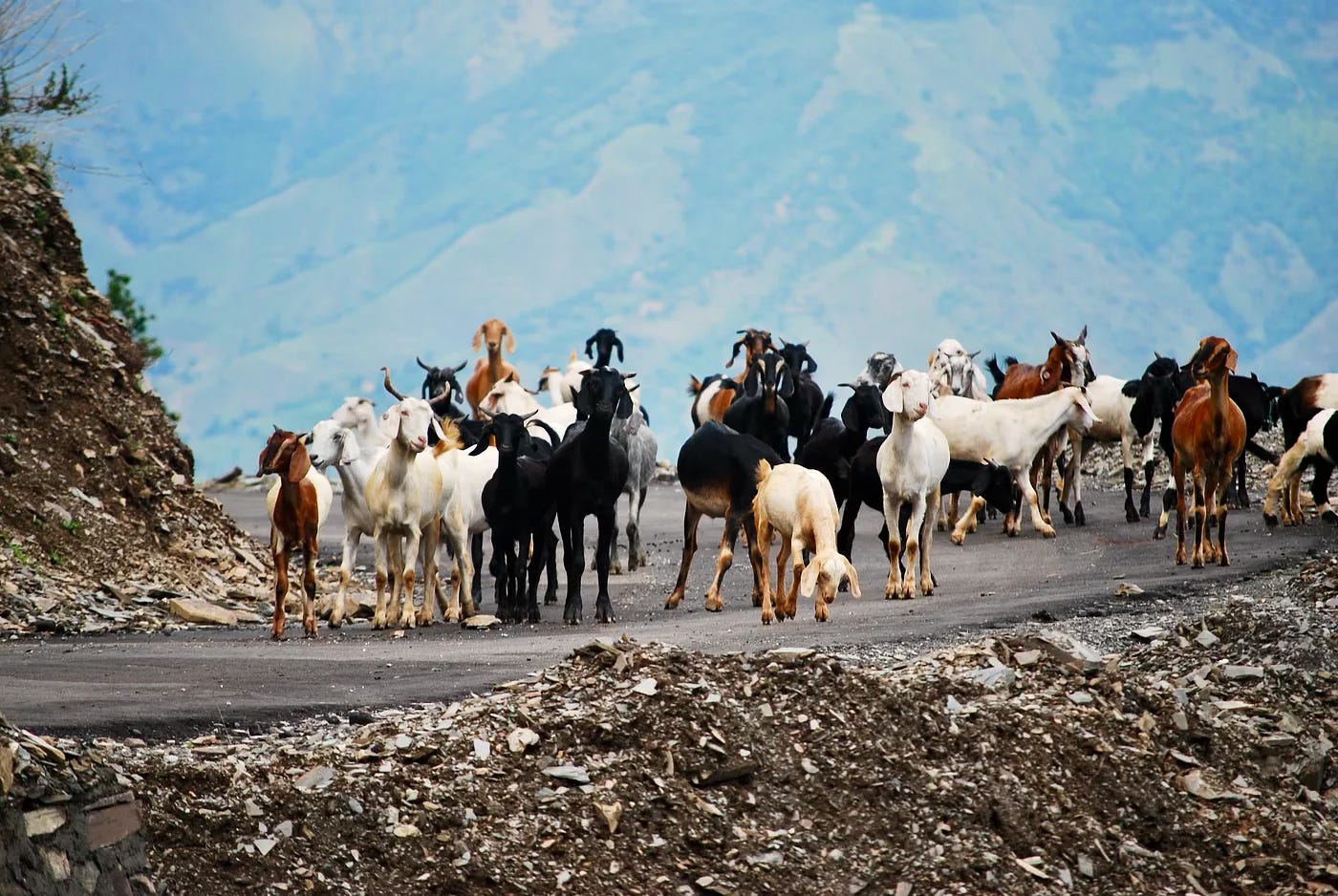
Hukam Singh Ji from the village walks home with a pile of foliage for his goats. A herd of goats trails him at a distance, watched casually by their minders.
Elderly Budhiram Ji guides his cattle down a slope to a shed in his field, where he lives, away from his family in the village. Struggling with a hunchback, he walks slowly with his stick and stops to request some change for a beedi. He nods when reminded that smoking is harmful but his face crinkles into a smile when his wish is fulfilled.
Other than the bird tweets and dog barks when a fox or jackal appears in the foliage around here, the peace is only occasionally pierced by a local bus plying from the villages to the towns downhill — loudly honking to call attention of the villagers — or a bright red pick-up truck jerking more loudly over the monsoon potholes than a jarring band of bad musicians. Vehicles, far and in between as they are, all appear and disappear around the multitude of hair-pin bends in the serpentine roads that look like ropes holding the green blankets of foliage together around the mountains.
The western sky turns golden as the cotton-white clouds start rolling down the mountain tops to find home in the valleys for the night. The setting sun casts long shadows across the mountain range, and along Harul’s long balcony corridors.
The quiet deepens when occasionally the region suffers power failure after a heavy downpour, making us more meditative in the darkness and solitude. As the early monsoon clouds cover the mountain tops around the valleys, they trap the heat and the growing humidity often results in nightly downpours, some of them thick and long enough to panic us into alertness for the night.
I rise up in my bed in the darkness, lit up only by sharp but silent lightning and wonder: Is it nature wildly beautiful or beautifully wild?
(The writer is a former journalist and communications professional.)
This is beautiful writing! Great nature descriptions. And that Moscow animal, ha ha. Yet as a native muscovite I feel compelled to argue that Moscow's inhabitants are not always as tough as they look 😅