

I am in the forest this early spring morning. It is some time till dawn, so everything is still dark and hazy in the last forest mist of the short winter. Birds are building up an orchestra around me.
rrrrRAP-RAP-RAP-RAP! rrrrRAP-RAP-RAP-RAP! knocks the woodpecker.
Tik-tik-tik-tik! says the fantail.
Tuk… tuk… tuk… tuk… joins in the barbet.
Chee-chee-chee-chee! scolds the tailor bird.
rrrrRAP-RAP-RAP-RAP! rrrrRAP-RAP-RAP-RAP! tik-tik-tik-tik! tuk… tuk… tuk… tuk… chee-chee-chee-chee! Then comes the denouement: fssst! tsee! fssst! signals the fantail.
And then it repeats. In a continuing staccato.
The cacophony grows loud, overwhelming, so I run. But my green overalls restrict my limbs, and my feet are entangled in the web of creepers on the forest floor. My hair is thick and matted tightly. I stumble. My hands cannot rise and stop my fall. The ground is soaked in sanitiser liquid. I feel cold in my heart.
From darkness to light
“Uncle! Time to freshen up!” Fatima calls out in my nightmare. I wake up. I am in the cardiac care unit of a hospital, sleeping in a straitjacket after a procedure. The beeps from six heart monitors and the hisses and clinks from other equipment are creating the ominous musical background for my nightmare. Vague snippets of the experience on the surgery table the day before yesterday linger in my mind. It is 5 am on the wall clock.
Nurse Fatima, a woman in mid-twenties, bears the quiet, slight, and fair features of the local people from the hills. She helps me up to a sitting position. “Keep your left hand like this, Uncle,” she positions it on my stomach gently, and helps me down to a standing position. She brings a pair of sandals for me. “Ajay! Take Uncle to the washroom and change his clothes.”
General Duty Assistant (GDA) Ajay leads me by hand and cheers me with a smile: “Let’s go for a walk, Uncle!” After the washroom visit, he brings me back to the bed, pulls the curtains around me, and helps me to change into a fresh pair of white-and-blue robe and pyjamas, and a blue cap. Fatima hangs new medicine and fluid bottles on the bedside drip stand and re-fixes the intravenous tubes onto my right arm.
All six patients are freshened up. Fatima takes turns with nurse Deepika to help the patients get up and ready, and reload them with medicines. Ajay and his female GDA colleague Pinky assist in cleaning up and getting into fresh hospital clothes. The patients are under constant watch, some having gone through procedures, and the others being prepared for some.
The palette of patients
My next-bed neighbour, Ved Prakash Ji, was brought in to the emergency ward the previous night in severe pain. With a heavy build and a thick moustache, he may have celebrated his 50th birthday recently. After medication, his pain has subsided. He’s desperate to go to the washroom.
“Do you have pressure for motion?” Fatima checks.
“No, but I have to pass urine!”
“Uncle, you need not worry about that. You have a catheter in place.”
Slender and golden-haired Dadi Ma (Grandma), on the opposite side of my bed, dithers on whether she can walk to the washroom or needs assistance at the bedside. Deepika and Pinky eventually persuade her to walk to the washroom as per the cardiologist’s advice to mobilise her.
Sugarless tea arrives as the nurses and care assistants help us settle into the morning beat. With healthy brown sugar pouches on the side. Breakfast will follow soon. Each patient has her customised breakfast as prescribed by the dietician who visits us twice a day. I have now graduated to a normal diet, so I get to enjoy a bowl of healthy noodles. Ajay feeds me with a spoon despite my protests that I can manage it myself.
Dadi Ma refuses to eat. She says Doctor Sahab has asked her to avoid food so she doesn’t soil the bed or have to leave the bed for managing her motion. Deepika stresses that the doctor didn’t say so, that it’s okay either way, they will take care of things, and she doesn’t need to worry. Dadi Ma still keeps her breakfast bowl away.
Mornings measured in beeps
After breakfast, I am sleepy and supine, depleted from Ved Prakash Ji’s loud cries of pain last night and then my own pain and nightmares. But my daytime daze is broken by the mobile X-ray team, which has to take a snapshot of my chest cavity.
The young X-ray technician with a studious look through her round glasses covers herself in a protective vest and announces “Expose!” so the rest of the staff move out of the exposure range. This is repeated for Dadi Ma too. “Hilo mat, Dadi Ma!” (Don’t move, Grandma!) The technician and Deepika instruct the septuagenarian lady sternly. It emerges that her involuntary motions spoiled the X-ray shot they had taken earlier.
A young, bearded Dr. Joseph, the resident cardiologist, makes a round of the patients with a junior Dr. Varsha, checking their latest test reports and vital readings, and asking them how they are feeling.
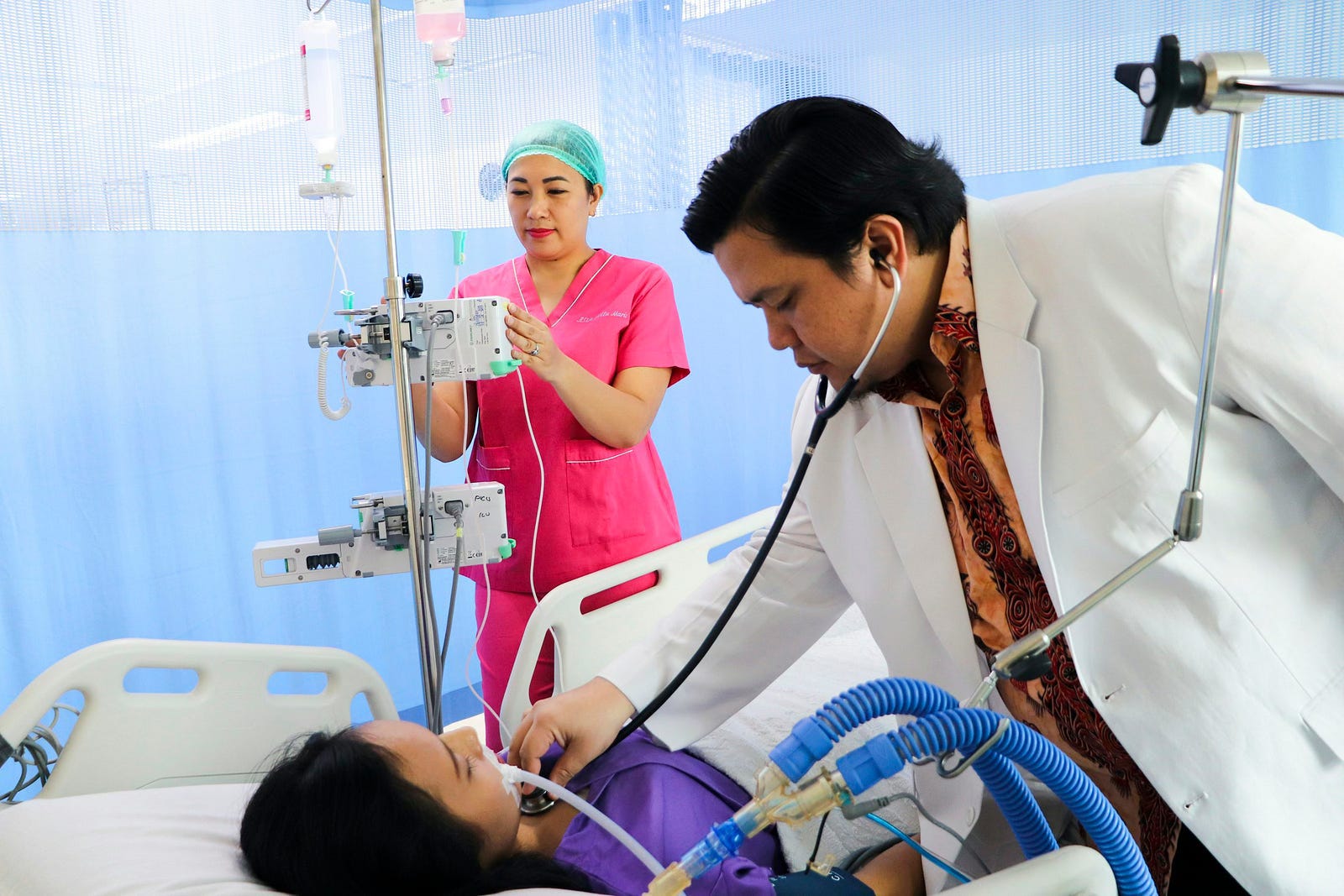
Dr. Hruday Samrat, the cardiac surgeon, arrives at 9:30 to check on his patients. He is well-known for being soft-spoken and the one who still examining each patient with a stethoscope. But when it comes to discipline, he is hard-hearted. All medical staff hide their already discreet mobile phones like spyware before his arrival. I heard the previous morning in the emergency ward, during my admission process, how he would pull staff up for being even slightly negligent, so they were all extra careful in preparing me for the procedure. Yet, the nurses and GDAs were not prepared for his outburst when he found that I was not ready to be rolled out to the cath lab for the procedure at the appointed time. The emergency ward staff had messed up.
When scolding becomes care
This morning, briefings and updates by Dr. Joseph and Dr. Varsha are all routine until Dr. Samrat approaches the bed of Ved Prakash Ji, whose penchant for medical misdemeanour unravels. The soft-spoken cardiologist takes a look at his file and bursts out: “You have had two heart attacks in two years. And yet you’re not taking the medicines! You are not treating the treatment seriously! Why do you come to the hospital at all? Why?” The room and the corridor fall silent. The loud, staccato monitor music is the only indication that the hearts are beating. Fast. The tall cardiologist’s nervous tic of shaking his right leg while talking only stops for a moment.
In the course of the morning, a new team of nurses and GDAs takes charge. After lunch, nurses Ankita and Maria prepare Dadi Ma and the other female patient in the room, Prem Lata Ji, for their procedures. After having two stents installed in her heart by two of the newest private hospitals in the city, Prem Lata Ji has decided to surrender herself to Dr. Samrat’s capable scalpels in this older hospital. Younger than Dadi Ma at least by a decade, she is all stoic and brave, but develops jitters when the time comes for her to be wheeled into the cath lab. It takes some cajoling by the nurses to convince her to continue to be brave.
When the rest of the four patients are quieter, the beeping monitors only sound louder. Ankita complains to her colleague Mukesh, who has replaced Maria, about the nurse-in-charge in a whisper near my bed: “How can she send you to the Recovery and post Maria here? There is only one patient there, and Maria can take care of him. If needed, we can always go and check on her!”
Between shifts, between lives
Maria is a newbie nurse, one week fresh in this hospital. She was on duty when I was in the Recovery room yesterday, before a bed became available in the CCU for me. The Recovery room also functions as a break room for nursing staff and assistants, so there is a more relaxed feel to it. They chat, share notes on life, family, and career, and at times, have small bites with tea, and they rest in turns.
Hailing from Amritsar, Maria moved to Dehradun recently after marrying a senior supervisor in a biochemical company. A single child of her parents, she worked in a local hospital in Amritsar. She got an offer from a new private hospital with a higher salary, but without health insurance benefits, so she chose to join this hospital.
Maria now lives in her husband’s large joint family, with three brothers and their families, and parents living in the same house, though using separate kitchens. Within her first week in this hospital, she had a brush with a senior colleague, after which she was moved to the CCU team.
Nurse Mukesh commiserated with her, saying that the colleague was known to be difficult: “Don’t worry, he is like that, don’t take it to heart. The best strategy here is to do your job and leave at the end of your shift; don’t be a hurdle in others’ work. That way you’ll not step onto anyone’s toes.”
Maria spent her shift at my bedside watching my heart monitor, on her toes all through. I sensed her paces were shaky in her eagerness to prove herself.
“Have you had tea?” asked Mukesh, who had come in drenched in an untimely shower. He was sipping a cup of tea while drying his jacket in the golden glow of the room heater under their desk. The warm corner was a refuge for the staff at night, especially one female GDA who rarely left the spot.
No, Maria replied.
“Have a cup, and sit down,” he tried to calm her down. “You already worked in a hospital and will get the hang of the CCU soon enough.”
Back in the CCU, Ved Prakash Ji has been repeatedly requesting washroom breaks. The nurses allow him to go a few times, but he reports no success with his motion or urine. “I can’t even pass urine!” he keeps pleading, despite his urine bag filling up.
“You just went to the washroom, Uncle. If you don’t pass stool after so many trips, why do you want to go again? What’s the matter?” wonders Ankita aloud.
I have my suspicions. I noticed traces of ash in the washroom when I went one time after Ved Prakash Ji. Not that it matters much, given the washroom’s cleanliness had already gone down the toilet.
Silent type, waiting type
On the third day, Dr. Samrat changed my dressing and approved my discharge. A heavy pile of reports, internal notes, and prescriptions is sent downstairs for processing and approval from the insurance company. My day passes in waiting.
I recognise nurse Paramjit, whom I had met on arrival in the Recovery room the first day. She is back after a day’s break. I say hello, and her pimpled face beams wide. “You recognise me! Of course you do: I bombarded you with questions!”
Her questions were a way to calm my nerves before the procedure, I had assumed. “What is your name?” she had asked, looking at my records. “Who gave you that name? What does it mean? That’s lovely! And your wife’s name?”
She is from Batala in Punjab, famous for its cast iron machinery and weapons manufacturing. As she puts prescription drops in my eyes, she whispers to me in a conspiratorial tone, “He is very irritating, isn’t he?” referring to Ved Prakash Ji. I nod, eager to be discharged.
“Kya, main kam bolne wala hoon?” she questions. (What, you are a silent type?) I nod again.
“Don’t worry, Kanti Ji! We will discharge you as soon as the file is back!” She is the only staff member who calls me by name.
“I’m not leaving you guys so soon. Will have dinner here before going home!” I joke.
Time, pending clearance
Although I say that in jest, Paramjit still books dinner for me when the dietician visits. “You never know. One patient got discharged late last night, after 12 hours’ waiting for insurance approval. He went home hungry,” she explains. I nod.
Next, she is counselling the bearded young patient who has to do exercises for breathing problems and seems depressed. He has recently lost his engineering job in a large tyre company. “Please don’t worry so much, Anil Ji. You have so much to live for: this health issue and job problem are both short-term. I’m sure you’ll be fine.”
Dr. Samrat has taken his evening round. He is surprised to see me hunched over on the bed. Waiting for the insurance engine to run, I explain. “I have signed the papers; when it’s time to pay, they take their own sweet time,” he comments, uncharacteristically. I nod. He asks Paramjit to give me another antibiotic dose for the night.
Blood is thicker than saline
Attendants of the patients walk in during the evening visiting time. Dadi Ma is exhausted after her procedure, and her monitor beeps in a sedentary tone. Her granddaughter caresses her hands for warmth. Her monitor graph jumps, and the beeps come alive. She wants milk instead of the pre-dinner soup. Milk will be some time coming, so she is offered soup to revive her energy. But she is already sitting up and smiling. She motions to assistant Vinod, who has been cleaning and helping through the day, and passes a few notes to him. “This is not allowed, here, Dadi Ma! We will lose our jobs if found out,” he exclaims.
Ved Prakash Ji complains to his wife about not being allowed to go for his motion. “Aap to kisi ki shunte nahin ho. Ab to yeh buri adat chhod do, dil ke wastey!” (You don’t listen to anyone. Stop this bad habit now, at least, for your heart’s sake!) she pleads to him in hushed tones.
My daughter has been coming to see me and to update me on the insurance claim process. I have to deal with their many queries about past medical history and records. My frustration probably shows. Paramjit comes over and assures me, “Koi nahin (no worry), we will serve you morning tea and breakfast too if needed.” I nod with a smile.
My wife outside is worried as she hasn’t seen me since yesterday. But they don’t allow her in: only one attendant is allowed to use the visitor pass for the CCU. She requests Imran Bhai, the genteel and calm man at the OPD reception, to find a way. He says, “You called me your bhai (brother), right? Then I must do it for my sister.” He calls someone upstairs, and my wife comes to see me, face creased with worry and exhaustion. “No matter what, we will take you home today. You will sleep in your bed tonight,” she declares with teary eyes.
There is no green light yet when dinner is served. I regret my joke earlier today.
Laughter, despite everything
Hasika, a lean and chirpy young nurse, is entertaining her colleagues by mimicking a doctor.
“I can explain: see, we did this procedure without any cutting, splitting, or plotting.” I can’t see if her leg is shaking, but her colleagues spill into muffled laughter.
Another nurse pretends to be an intern: “Sir, why is this patient having difficulty breathing?”
“I can explain: see…”, Hasika fakes an explanation in a low whisper so the patients cannot hear. The team erupts in laughter and disperses.
As Hasika heads to the door, I waylay her: “Doctor Ma’am, please explain, why is insurance claiming my time so much?”
“I can explain: see, when it comes to cash, it can’t be cashless. So they have to be heartless, which takes its own sweet time.”
The whole room laughs this time.
The titter of the laughter fills my heart when I leave the hospital after the 12-hour wait, pooling from family savings to pay the bills. The orchestra of the monitors’ beeps fades away as I am rolled out into fresh air in a wheelchair.
This is great little piece about being in the hospital for a pacemaker. The good vibes of the hospital staff are evident. I like the Hindi interspersed with the English. The main characters are each patient or impatient patients depending on how they perceive how they are doing, which is interesting with not that much explained except their main concerns in how to get by after or before a procedure. Hope you are feeling much better after this jaunty experience. I like the supna or dream at the beginning and how the perceived fall in the forest links up or seems like it might with link with the procedure or reaction to having undergone it, the worst part of the procedure coinciding with the slippery fall. Interesting how one's mind interprets experience. A great snapshot of a pivotal moment as others and oneself experience it. Thanks for this.
An easy to read story respiring kindness and interest in others. It is much more than a candid narrative of a trying personal experience. The characters come out wonderfully and descriptions are so vivid. Congratulations on turning a difficult time and moment into a good story.