

“You both look so beautiful!”
It was a young woman who had just overtaken us from the side. We were walking along a narrow lane in Kolkata, hand-in-hand, for an evening stroll. She came from behind, about 30 years in age, clad in an elegant modern trousseau of black palazzo trousers matched with a black-and-white shirt, topped with a grey scarf at the neck. Her steps strident in formal shoes, she turned towards us, peering through her glasses sincerely.
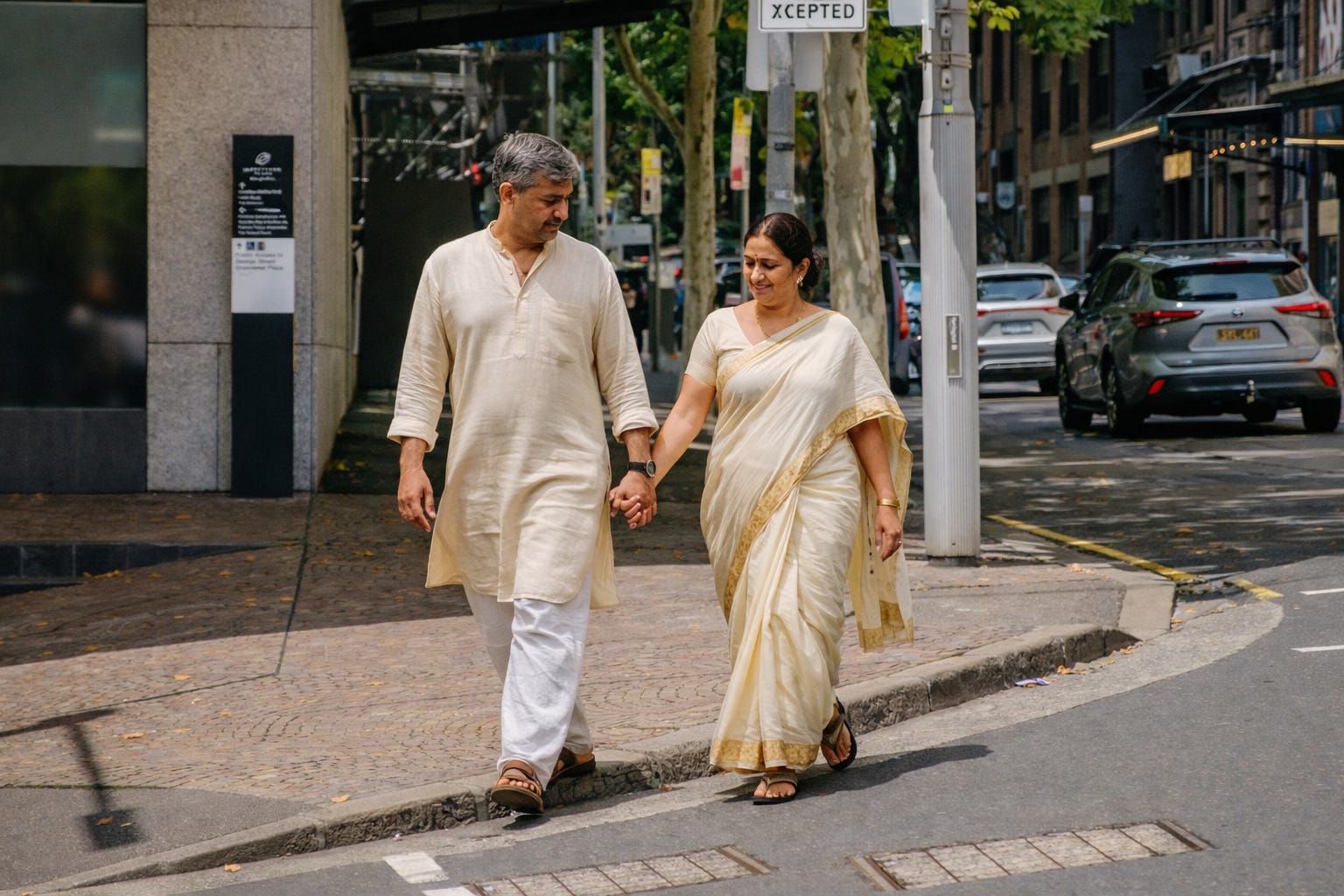
“You are pretty, both of you!” she said again, as if we might not have heard her the first time. “I really appreciate it.”
We thanked her, more embarrassed than amused, and watched her walk ahead.
The scenario was quite the opposite earlier in the day. We were walking to our flight departure gate, hand-in-hand. A couple of teenage girls walked by, whispering to each other and giggling. Their looks said it: “Ew, why are these two acting so strange!”
We understood both reactions.
When we were dating three decades ago in Delhi, my girlfriend and I spent our afternoons searching for secluded corners — public parks, quiet stretches of road, anywhere we could sit undisturbed. Public displays of affection were rare then. Our lower-middle-class inhibitions were even stronger. Holding hands felt daring; being seen hand-in-hand felt dangerous.
On a joy ride to Suraj Kund in Haryana, we were stopped at the border by a Haryanvi cop. “Kya lagti hai yeh teri?” he asked, pointing his shining danda (baton) towards my girlfriend. (What is your relationship with her?) My girlfriend moved her hand away from my waist.
Sis... I was about to blurt when his danda landed on the headlight, with a light thud, just above the front panel where a PRESS sticker announced my profession. “She is a colleague. We work in the press,” I exhaled in relief. The danda moved aside, and we moved ahead.
Marriage did not make us braver. We had married against the wishes of our families — rebellion enough for one lifetime. In our middle-class neighbourhood, expectations pressed heavily on my bride. Newlyweds were meant to behave with restraint. The only hands we held freely were those of our daughter, teaching her to walk, to write, to cross the street.
Our residence in Europe was more illuminating. In fact, in the early phase, we tried to distract our daughter’s attention away from the explicit public display of intimacy to prevent culture shock. Gradually, she knew better, and so did we. Holding hands was no longer an embarrassment. Indeed, it became necessary.
On our first journey abroad, at Frankfurt airport, we stood before a towering escalator leading to the train station above. Our suitcases were enormous — stuffed with clothes, spices, a pressure cooker, fragments of an Indian life we were unwilling to abandon.
Staring up the massive moving staircase, I froze. How do I carry our humongous suitcases, overloaded with our Indian lives, up the folding and interlocking metal stairs? How does one carry such weight up moving stairs?f
A stranger, without ceremony, lifted one suitcase onto the escalator and rode it up. He returned for the second. I reached instinctively for my wife’s hand as she stepped onto the escalator for the first time in her life. By the time we reached the top, something had changed. The handhold felt less like romance and more like alignment.
In London, on a Tube train, I was once flung into the lap of a grandmotherly woman when the carriage lurched violently between stations. I had been studying the Underground map, too engrossed to notice the curve. The overhead rails were just out of comfortable reach. So when the train screeched to a stop on the left, I flew right into the arms of Grandma Dame. Since then, holding hands has become less optional.
I developed a habit of straying — even with a digital map guiding me. A few distracted steps ahead, and I would drift off course. Family legend says I once got blindsided by the size and signboard of an IKEA store we were headed for, right in front of us, and took a sharp left for the Coventry Market, famous for its old-school charm. The gentle pull of my wife’s hand would save me from wandering, without comment. A silent, private navigation system.
We could not explain all this to the Young Lady in Kolkata. Holding hands has now become as essential as the pacemaker newly fitted inside my chest — a quiet mechanism that keeps rhythm when the body hesitates.
Kolkata does not make walking easy. Pavements rise abruptly or vanish altogether. Hawker stalls claim their share of space. Manhole covers — stamped solemnly with municipal initials CMDA — threaten betrayal during the rains. Cars edge too close. Rickshaws weave unpredictably. A sudden vehicle slices through the narrow corridor of traffic as though urgency were hereditary. “Tor baper rasta na ki re?” is the common verbal rebuke by the less privileged. (Is it your father’s road?)
The safest course is to avoid the sidewalk and walk on the street, waving your way around parked cars, rickshaws, hawker carts, garbage, construction materials, and homeless people. We keep ourselves ready to pull the other away when a haywire speeding car suddenly curves in your slow, serpentine lane, Young Lady!
Young Lady, it is not a performance. It is logistics. It is insurance against potholes and sudden curves.
It is a pact made quietly somewhere between the two continents. If it looks like romance, we’ll take the compliment.
Like we did at the departure lounge in the morning. A little girl of 4 or 5 came, freeing herself from her mother’s grasp, ran towards us, and greeted my wife with folded hands: “Namaste!” Just like that.
“Namaste, Beta. God bless you,” is all we could say, hand-in-hand, smiles on our faces.
(The writer is a former journalist and a communications professional.)
Hi Kanti! Hope you are all doing well
Viv